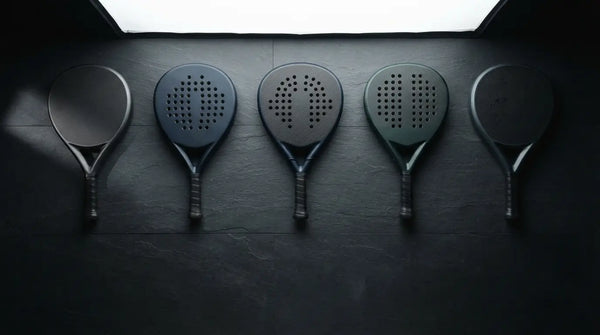
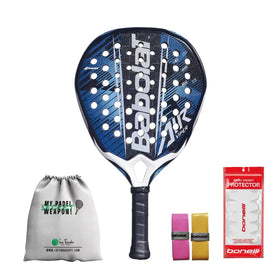
Short answer: round puts the sweet spot in the middle of the face and trades power for forgiveness. Diamond pushes it high and trades forgiveness for power. Teardrop sits between them. Hybrid is a newer attempt at diamond power with teardrop tolerance. If you cannot yet hit the middle of the face on demand, that decision is already made for you: round.
This guide goes one level deeper than that. Below is what the shape physically changes, what the ratings across our own catalogue actually show — including where they contradict the usual advice — and where the averages are hiding something you should know about.
What head shape actually changes
Shape is really a way of describing where the mass sits. A round head puts more of the frame's material low, near the throat. A diamond head puts it high, near the tip. Teardrop is in between, and hybrid varies by model.
Moving mass up the frame does two things at once, and they pull in opposite directions:
- It moves the sweet spot up. The sweet spot is the part of the face that returns the most energy to the ball and transmits the least shock to your arm. On a round frame it sits near the geometric centre. On a diamond it sits noticeably higher, closer to the tip.
- It makes the sweet spot smaller and the miss more expensive. Concentrating mass high increases the leverage the frame has over the ball — and the leverage a mishit has over your wrist and elbow.
That is the whole trade. Everything a shop can tell you about shape is a consequence of those two sentences.
What our catalogue shows
We rate every racket we carry from 1 to 100 on control, power, manoeuvrability, sweet spot and forgiveness. Averaged across the 85 rackets and bundles currently in the La Tienda Egypt range:
| Shape | We carry | Control | Power | Sweet spot | Manoeuvrability | Forgiveness |
|---|---|---|---|---|---|---|
| Round | 20 | 89 | 60 | 82 | 82 | 76 |
| Teardrop | 20 | 85 | 75 | 76 | 73 | 71 |
| Diamond | 37 | 74 | 87 | 74 | 73 | 74 |
| Hybrid | 3 | 83 | 85 | 73 | 81 | 73 |
Two things in that table are worth stopping on.
Round is the most manoeuvrable shape by a clear margin — and teardrop is not more manoeuvrable than diamond. Round averages 82 against 73 for both teardrop and diamond. That cuts against the common line that teardrop is the nimble middle option. In our range it is not; it is the middle option on power, while handling much like a diamond.
Round holds a bigger sweet spot than anything else we stock — 82, against 76 for teardrop and 74 for diamond. If you are mishitting, that eight-point gap is worth more to your results than any amount of extra power.
Shape predicts intent almost perfectly
Every racket in our range is also classified by playing style: control, balanced or power. Cross that against shape and the relationship turns out to be close to absolute:
| Shape | Control rackets | Balanced | Power rackets |
|---|---|---|---|
| Round | 17 | 3 | 0 |
| Teardrop | 2 | 10 | 8 |
| Diamond | 0 | 11 | 26 |
| Hybrid | 2 | 1 | 0 |
Not one of our 20 round rackets is a power racket, and not one of our 37 diamonds is a control racket. Across 80 frames from eight brands, the two extremes never cross over. Teardrop is the only shape that genuinely spans all three columns, which is the real argument for calling it the middle shape.
The practical use of this: if you already know whether you want to build points or finish them, you have narrowed 85 rackets to a shape before you have looked at a single price tag.
Round — the middle of the face, at every level
The sweet spot sits where a developing player actually makes contact, which is why it is the standard first-racket recommendation. It is also the shape to pick at any level if you have elbow or shoulder history, or if you defend for a living and win points by not missing.
What surprises people: round is not a beginner-only shape in our range. Of our 20 round frames, 9 suit beginners, 10 suit intermediates and 8 are built for advanced players — four of those eight are signature frames carrying the names of professionals who play a control game, including Miguel Lamperti and Aranzazu Osoro. Round is the shape of a playing style, not of a skill ceiling.
Round is also the widest price range we stock, from 4,500 to 16,350 EGP, with a median of 9,599 — the lowest median of any shape.
Teardrop — the middle on power, not on handling
Balance sits higher than a round frame, so you gain power without giving up much placement: 85 average control against 75 power. It is the natural second racket for a player who has a season behind them and is losing points to where the ball lands rather than to how hard it was struck.
Be clear-eyed about what you give up, though. Teardrop's average sweet spot (76) and forgiveness (71) sit below round's, and its manoeuvrability is no better than a diamond's. You are buying a power step, not an all-round upgrade.
Teardrop is also the shape with the broadest style spread we carry — 10 balanced, 8 power, 2 control — so the shape alone tells you less here than it does at the extremes. Read the individual ratings, not just the silhouette.
Diamond — earn it first
Mass concentrated high means the frame arrives at the ball with more behind it, and diamonds average 87/100 power, the highest of any shape we carry. The bill comes as a sweet spot that is smaller and higher up the face, at 74 average control.
It is the most-stocked shape in our range, 37 of 80, and that is a fact about who buys premium rackets rather than a recommendation: 28 of those 37 are built for advanced players. A diamond punishes the mishits that every player below that level still makes several times a game.
Diamond is also the most expensive shape to enter — nothing below 6,499 EGP, with a median of 12,999.
Hybrid — too new for us to generalise
A profile aiming for diamond power with teardrop tolerance. Our three hybrids average 83 control and 85 power, and interestingly hold round-like manoeuvrability at 81.
Three rackets is not a sample. Treat those numbers as a description of the three frames we happen to stock, not as a claim about the shape. We would rather say so than round the number up into a trend.
Where the averages mislead
Averages make shapes look like separate categories. They overlap heavily. Here is the actual spread within each shape:
| Shape | Control range | Power range |
|---|---|---|
| Round | 70 – 100 | 30 – 80 |
| Teardrop | 70 – 100 | 50 – 90 |
| Diamond | 50 – 90 | 60 – 100 |
| Hybrid | 80 – 90 | 80 – 88 |
Our best-controlling diamond rates 90 — higher than our worst-controlling round, at 70. A well-chosen diamond can be more controllable than a poorly-chosen round. Shape narrows the field; it does not decide the answer. Once you have a shape, compare the individual ratings inside it.
What shape does not decide
Shape is the biggest single variable, but three others move the feel of a racket enough that ignoring them will get you the wrong frame in the right silhouette:
- Core hardness. A soft EVA core in a diamond is far more forgiving than a hard core in a teardrop. Core can partly undo what shape does.
- Face material. Fibreglass flexes and forgives; carbon is stiffer and more precise. A fibreglass diamond and a carbon diamond are different rackets.
- Weight and grip. A frame that is 20g too heavy for you will feel wrong in any shape — and two overgrips change how a racket handles more than most players expect.
All three are covered in the full guide to choosing a padel racket.
Which shape is yours
- Still finding the middle of the face? Round. Nothing else in this list matters yet.
- Elbow, wrist or shoulder history, at any level? Round, soft core. This is not the beginner answer, it is the medical one.
- Consistent contact, losing points on placement? Teardrop with a control bias.
- Consistent contact, losing points because you cannot finish? Teardrop with a power bias, or a hybrid.
- Already finishing at the net, mishitting rarely? Diamond.
- Defending most points by choice? Round, at whatever level you play. Eight of ours are built for advanced players.
Three things people get wrong about shape
- "Diamond will make me hit harder." It adds power to a clean strike. It subtracts more than that from a strike off the lower half of the face — and that is where most non-advanced contact lands.
- "Round is what you grow out of." Half of our round frames are built for intermediate players and 40% for advanced ones. Plenty of good players choose round permanently.
- "Teardrop is the safe middle." Safe on power, yes. On sweet spot and forgiveness it sits closer to a diamond than to a round frame.
Where to go next
The 60-second racket quiz filters by shape directly, so it is the fastest way to see only the frames in the shape that suits you. Otherwise, go by level:
- Best padel rackets for beginners in Egypt
- Best padel rackets for intermediate players in Egypt
- Best padel rackets for advanced players in Egypt
Or browse every racket we carry. All ratings quoted above are the ones shown on each product page, so you can check any claim here against the frame itself.