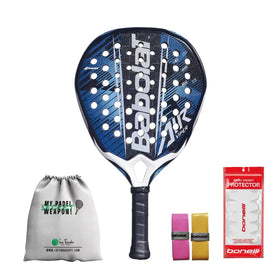
Short answer: buy a round racket with a soft core if this is your first one, move to a teardrop or hybrid once you have a season behind you, and take a diamond only when you are already finishing points at the net. Head shape decides more about how a racket feels in your hand than the brand, the colour or the price does.
That single line is the right advice for most people who ask us. The rest of this guide explains the reasoning behind it, so you can recognise the cases where it does not apply to you.
Shape is the decision that matters most
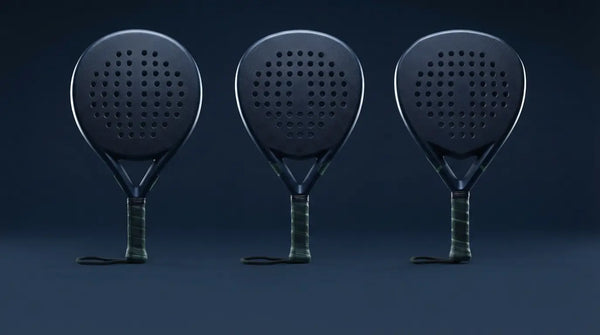
A padel racket's head shape moves the sweet spot — the part of the face that returns the most energy to the ball — up or down the frame. That one change cascades into everything else: how much power you get for free, how much control you keep, and how badly you are punished for hitting off-centre.
We rate every racket we carry from 1 to 100 on control, power, sweet spot and manoeuvrability. Averaging those ratings across the 85 rackets and bundles currently in the La Tienda Egypt catalogue makes the pattern hard to miss:
| Shape | We carry | Avg control | Avg power | Avg sweet spot | Avg manoeuvrability |
|---|---|---|---|---|---|
| Round | 20 | 89 | 60 | 82 | 82 |
| Teardrop | 20 | 85 | 75 | 76 | 73 |
| Diamond | 37 | 74 | 87 | 74 | 73 |
| Hybrid | 3 | 83 | 85 | 73 | 81 |
Read the first two rating columns together. Round frames average 89/100 control against 60/100 power. Diamond frames almost exactly invert that, at 74 control against 87 power. Teardrop sits between the two, which is precisely why it tends to be a player's second racket rather than their first.
The same split shows up in how the rackets are classified: 26 of our 37 diamond frames are power rackets, and 17 of our 20 round frames are control rackets. Shape and intent travel together.
Round — the beginner's shape, and not only the beginner's
The sweet spot sits in the middle of the face, which is where players who are still learning actually make contact. Round frames carry the highest average sweet spot (82) and the highest average manoeuvrability (82) of any shape we stock, and they are the cheapest way into a real racket — ours start at 4,500 EGP.
Round is also the correct answer for anyone with elbow or shoulder trouble, at any level, and for defensive players who win points by not missing.
Teardrop — the natural second racket
Balance sits slightly higher than a round frame, so you gain power without giving up much placement: 85 average control against 75 power in our range. If you have played a season or two and find that you are losing points to where the ball lands rather than to how hard you hit it, this is usually the honest upgrade.
Diamond — earn it first
The weight sits high in the head, so the frame arrives at the ball with more mass behind it. That is why diamonds average 87/100 power, the highest of any shape we carry. The cost is a sweet spot that is both smaller and higher up the face: at 74 average control, a diamond punishes the mishits that every player below advanced level still makes several times a game.
It is the most-stocked shape in our range — 37 of 80 — because it is what advanced players buy, not because it is what most players should buy.
Hybrid — the newest of the four
A compromise profile aiming for diamond power with teardrop forgiveness. We only carry three, so treat our averages here (83 control, 85 power) as indicative rather than settled — three rackets is not a large enough sample to generalise from, and we would rather say so than pretend otherwise.
Weight
Padel rackets sit roughly between 350g and 390g. Lighter frames are quicker at the net, easier to defend with, and far kinder to your elbow. Heavier frames carry more mass into the ball and hold their line better against a hard shot.
If you are unsure, go lighter. A racket that is slightly too heavy causes injuries; a racket that is slightly too light only costs you a little power. Those are not equivalent risks, and one of them ends your season.
Balance
Balance describes where the weight sits along the frame. Low balance keeps mass in the handle and favours control and quick hands; high balance pushes mass into the head and favours power. Balance and shape usually move together — most round frames are low-balanced, most diamonds are high-balanced — which is why shape is a reliable shorthand for both.
Core: soft or hard
The core is the foam inside the frame, almost always EVA rubber. A soft core deforms more on impact, holds the ball on the face fractionally longer, and gives you comfort and control. A hard core returns energy faster for more power, but demands a cleaner strike to feel good.
One thing worth knowing if you play here: EVA softens as it warms, so a racket that felt firm in January will feel noticeably livelier in a July session. That is normal — but heat also damages rackets left in a car, which we cover in how to protect your racket from Egypt's heat.
Face material
Fibreglass flexes more: a softer, more forgiving feel, and less expensive. Carbon is stiffer, returning more of your energy for more precision and power, with less tolerance for a poor strike.
You will see carbon described as 3K, 12K or 18K. That number counts the filaments in each carbon strand — 3K means 3,000 — and it describes the weave, not the quality. A higher number is not automatically a better racket, and it is certainly not a reason on its own to spend more.
What to spend in Egypt
Across our current range, by the level each racket is built for:
- Beginner-suitable: 4,500 – 10,899 EGP, median 6,500 EGP
- Intermediate: 4,950 – 16,999 EGP, median 11,700 EGP
- Advanced: 7,499 – 17,999 EGP, median 13,000 EGP
You do not need to spend at the top of your band. Spend the least that gets you the right shape, the right weight and a core you find comfortable — then put the difference towards court time, which will improve your game considerably more than another 3,000 EGP of frame will.
The 60-second version
- First racket? Round, soft core, fibreglass or low-K carbon, 4,500 – 7,000 EGP.
- A season in, losing points on placement? Teardrop or hybrid with a control bias.
- Finishing points at the net already? Diamond.
- Any elbow or shoulder history? Lighter, softer core, round — and do not let anyone talk you out of it.
Three mistakes we see most often
- Buying the racket a professional uses. Signature frames are built around a specific player's swing speed and contact quality. The name on the frame tells you nothing about whether it suits you.
- Buying for the player you intend to become. A racket you cannot yet control does not accelerate your progress, it slows it down — you spend the season correcting the frame instead of learning the shot.
- Ignoring the grip. Padel rackets come in one grip size and you tune it with overgrips. Two overgrips change the feel of a racket more than most people expect, and they cost a fraction of a new frame.
Where to go next
If you know your level, go straight to the ranked picks:
- Best padel rackets for beginners in Egypt
- Best padel rackets for intermediate players in Egypt
- Best padel rackets for advanced players in Egypt
If you are not sure of your level, the 60-second racket quiz will place you, or you can browse every racket we carry.